Automatic Layer Winding Machine for Welding Wire Spooling with Mechanical Arm
| Brand Name | Hangzhou MetalWire Technology |
|---|---|
| Model Number | HRZU3000 |
| MOQ | 1 set |
| Price | Negotiable |
| Delivery Time | 45-60 days |
| Payment Terms | T/T, L/C |
Product Description
1. Overview
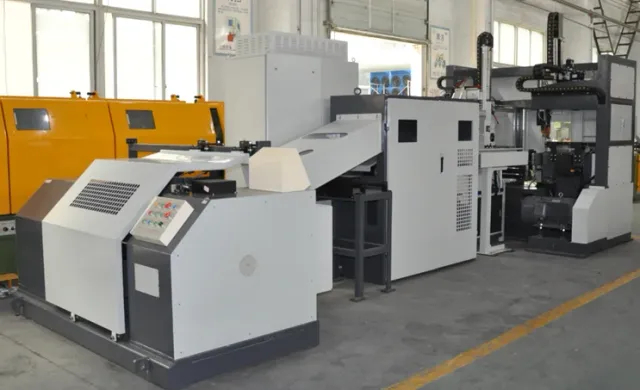
The automatic layer winding machine is a new-generation welding wire spooling system equipped with a mechanical arm. It automates plastic spool feeding, spool loading and unloading, wire cutting, bending, end binding and optional stacking.
The line runs at a maximum line speed of 30 m/s, with a typical operating speed of 25 m/s. Several design improvements ensure safety and reliability while reducing labor intensity and production costs.
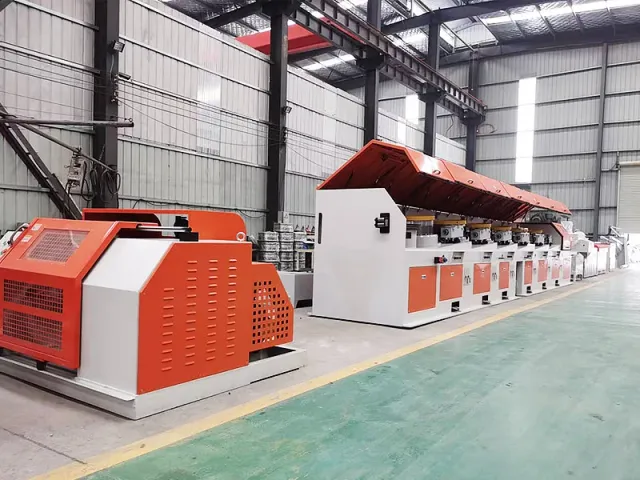
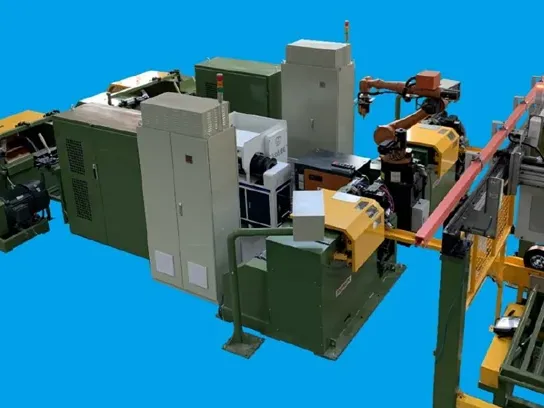
2. Equipment Composition
- Two layer winding machines, each consisting of: bobbin pay-off → machine → dancer → main winding machine → control cabinet
- One mechanical arm system, including tooling for layer winding
- One automatic plastic spool feeding machine
- Optional automatic stacking system
3. Automation Performance
- The feeding machine automatically recognizes each plastic spool and adjusts it to the correct orientation.
- The mechanical arm picks up the spool and loads it onto the layer winding machine automatically.
- Spool loading and unloading are fully automated.
- Wire bending at the beginning and end of each spool is fully automated.
- When the wire weight on the spool approaches the preset value, the machine slows down and stops. The mechanical arm then cuts the wire, bends the end and binds the end automatically.
- After winding, the spool is released and rolled out of the winding machine automatically.
- If the wire becomes tangled during winding, the machine slows down and stops, winds backwards until the tangled wire is cleared, and then resumes forward winding.
- A reserved communication port supports data collection and data manipulation.
- An optional system prints labels and attaches them to the spool automatically.
4. Human Assistance Required
Operators are required for:
- Loading and unloading the bobbin
- Butt-jointing the welding wire
- Adjusting the straightener
- Loading empty spools into the feeding machine
5. Main Specifications
5.1 Wire Specification
- Flux-cored welding wire: Ø1.0–1.6 mm
- Solid welding wire: Ø0.8–1.6 mm
- Wire ovality and diameter variation within one spool: less than 0.005 mm
- Winding speed: 0–30 m/s; actual speed depends on wire diameter and straightness
5.2 Plastic Spool Specifications
- Dimensions: Ø270 × Ø150 × 90 × Ø52.5 mm (maximum diameter × minimum diameter × inner width × shaft hole diameter)
- Spool capacity: 15–20 kg
- The bottom surface of the spool is grooved; the opening position must meet the spool drawing requirements.
- The wire diameter tolerance must be compatible with the spool groove.
5.3 Wire Spreading Control
The preset track layout method effectively identifies tangled wire conditions.
5.4 Straightener
The straightener has one horizontal group and one vertical group, each with 13 straightening rollers, for a total of 26 rollers. Each roller is fitted with a 6200 bearing.
5.5 Power Consumption
- Take-up machine: 15 kW AC servo motor
- Pay-off machine: 45 kW AC motor
- Power requirements may change depending on bobbin size.
5.6 Power Supply
- Three-phase 380 V / 50 Hz
- Total power: 124 kW
- Average operating power: ≤ 20 kW
5.7 Floor Area
The floor area is 5000 mm × 6000 mm (width × length).
6. Winding Machine Design
To support higher running speeds, the winding machine frame is reinforced with the following improvements:
- Integrated machine frame with a motor base; the main motor is mounted outside the frame with an individual gas circuit cabinet.
- The frame uses 20 mm welded steel plate in a box-type structure with annealing.
- Main machine weight: approximately 2000 kg.
- Improved bearings extend bearing performance and service life.
- The improved belt drive system increases rotational speed and reduces noise during high-speed operation.
- The main motor is a 15 kW AC asynchronous motor driven by a 15 kW frequency converter, enabling a running speed of 30 m/s.
6.1 Spreading Mechanism
- The junction plate on the spreading mechanism is made of aluminum alloy, and a hollow sliding rod reduces weight.
- When the main shaft speed reaches 4000 rpm, the spreading speed increases by 50%, producing a much higher impact force than before.
- To address this, the original 26-roller straightener was moved inside the dancer, leaving a 9-roller unit and a pressure wheel on the spreading mechanism to minimize weight and reduce impact force during reversal.
- The protective shield is manually controlled for overall safety; if it is not closed, the equipment can only run at low speed.
7. Safety
- The machine is equipped with an emergency braking system. The main winding machine and pay-off machine use cylinder wheel braking, allowing an emergency stop in the event of wire tangling or breakage.
- An emergency button on the control panel shuts down the machine immediately when pressed.
- The winding machine is covered by a shield that closes automatically when the machine starts.
- A reliable wire breakage detection device triggers an emergency shutdown if the wire breaks.
- The machine automatically alarms and stops when cylinder air pressure is too low, preventing the bobbin from falling.
- In the event of a sudden power failure, the overall running speed slows down under controlled conditions while kinetic energy from the bobbin supplies power to the PLC through the inverter.
- A protective fence is available on request. As with the protective shield, operation stops automatically if the fence is opened during operation.
8. Mechanical Arm System
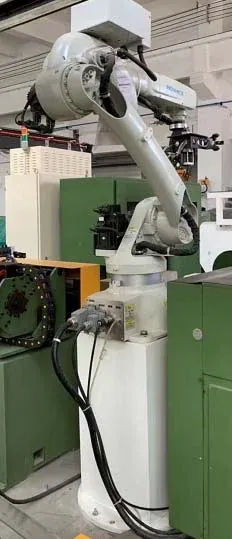
- The system uses a complete set of industrial robots with extended arms and a high load capacity.
- The robotic arm uses pneumatic solenoid valves and cylinders for reliable motion.
- Pneumatic clamps and scissors fully automate layer winding, loading and unloading of plastic spools, wire cutting, hook bending and end binding.
- An external control box controls robot operation, emergency stop and other functions.
- The system has a separate control system and electrical control cabinet.
- It exchanges signals with the layer winding machine PLC to ensure that the execution sequence of each action is maintained.
- Safety guardrails can be configured according to customer requirements to ensure safe operation.
9. Automatic Plastic Spool Feeding Machine
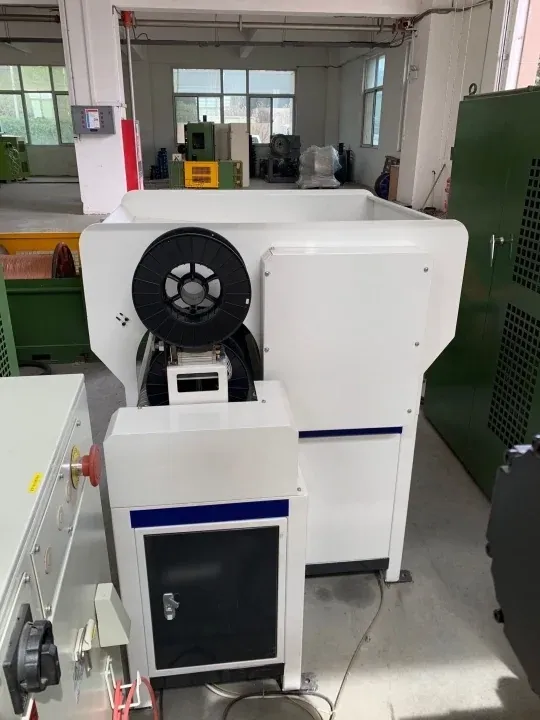
- Unlike the plastic spools used on traditional layer winding machines, the spools used with the automatic layer winding machine have a grooved inner core. As a result, the left and right sides of the spool are not symmetrical.
- The winding process normally starts on the left side of the spool, where a hole is predrilled to hook the wire. When the robot picks up the spool, it must grip the right side so that the spool is installed correctly on the layer winding machine.
- The operator only needs to place the plastic spools neatly in the hopper; they can be loaded in any orientation. The feeder recognizes each spool’s side orientation and presents it correctly for the robot to grasp.
- The feeder uses a 40 W AC motor controlled by a high-performance variable-frequency drive.
- Industrial sensors and push buttons are used for reliable operation.
- A PLC handles the control program and communicates with the PLC on the winding machine.
10. Automatic Stacking System (Optional)
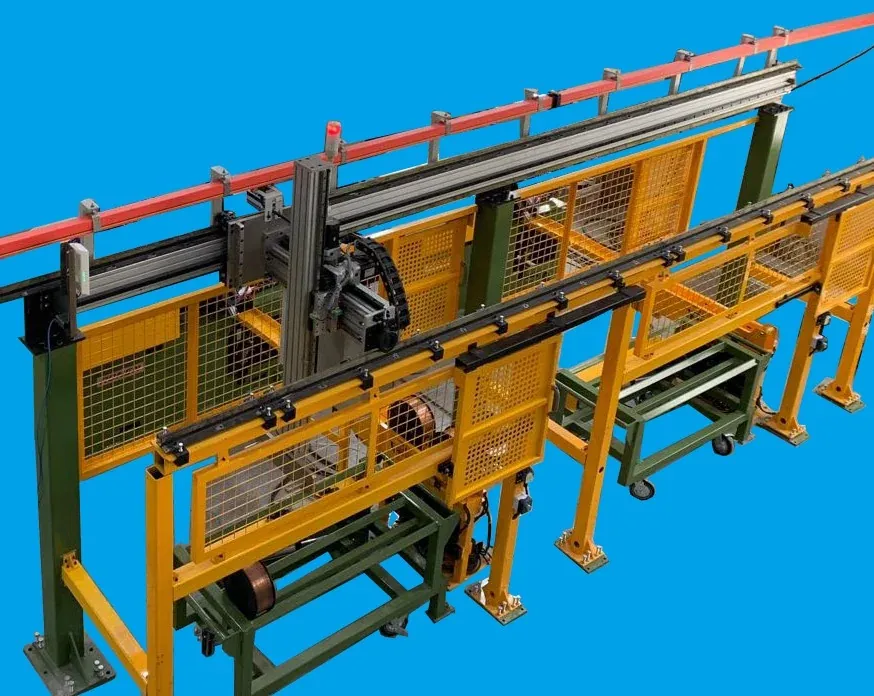
- Three-axis X, Y, Z movement.
- A built-in scale checks the weight of each spool. If the weight is outside the standard range, the machine stops and alarms.
- A servo motor, servo controller and PLC control the stacking axes.
- Each automatic stacking machine can handle three layer winding lines (six winding machines). If too many spools accumulate at a winding machine, the stacking system signals that machine to pause. The number of spools that triggers the alarm can be set on the touchscreen.
- The stacking system can learn the specifications of transport carts (location and height) to adapt to different working environments.
- It communicates wirelessly with the PLC of each winding machine and responds to requests in order.
- Press the emergency button to shut down the machine in an emergency.